
Drilling & Toolholding guide
How Collet Chucks Improve Accuracy and Tool Life in CNC Machining
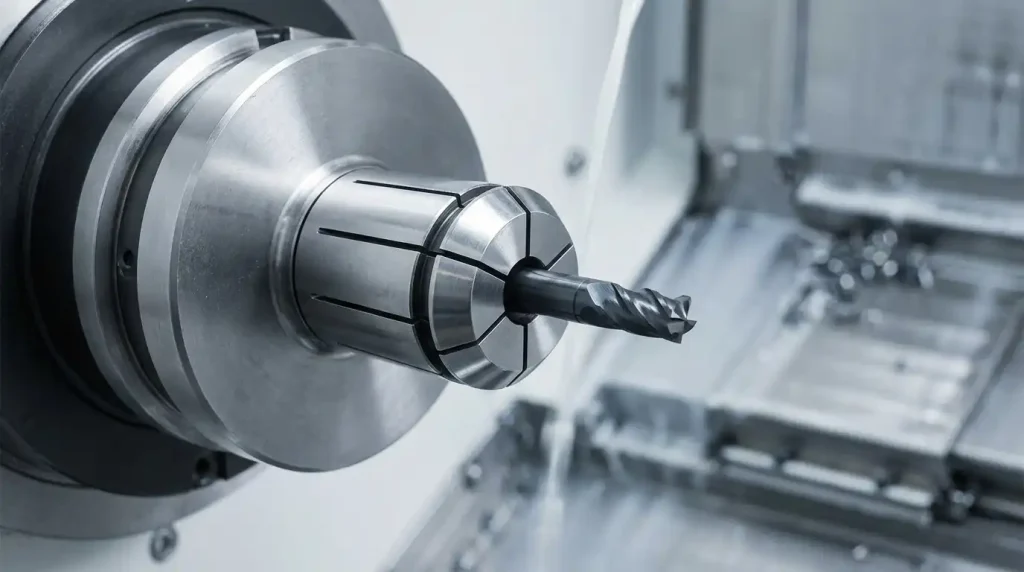
Why Collet Chucks Are Better for Precision Machining
Precision Machining Depends on More Than Just the Cutting Tool
When machining accuracy becomes inconsistent, many shops immediately look at spindle speed, cutting parameters, or tool quality.
But in many cases, the real issue sits between the spindle and the cutting tool.
The tool holding system has a direct impact on:
- Total Indicator Runout (T.I.R.)
- Surface finish
- Dimensional consistency
- Tool life
- Overall machining stability
Even high-quality carbide tooling cannot perform consistently if the holder introduces excessive runout or vibration.
This is one reason why precision CNC shops often prefer collet chucks for tighter tolerance work.
If you are still comparing common holder systems, you may also want to read our guide on the differences between drill chucks and collet chucks in CNC machining.
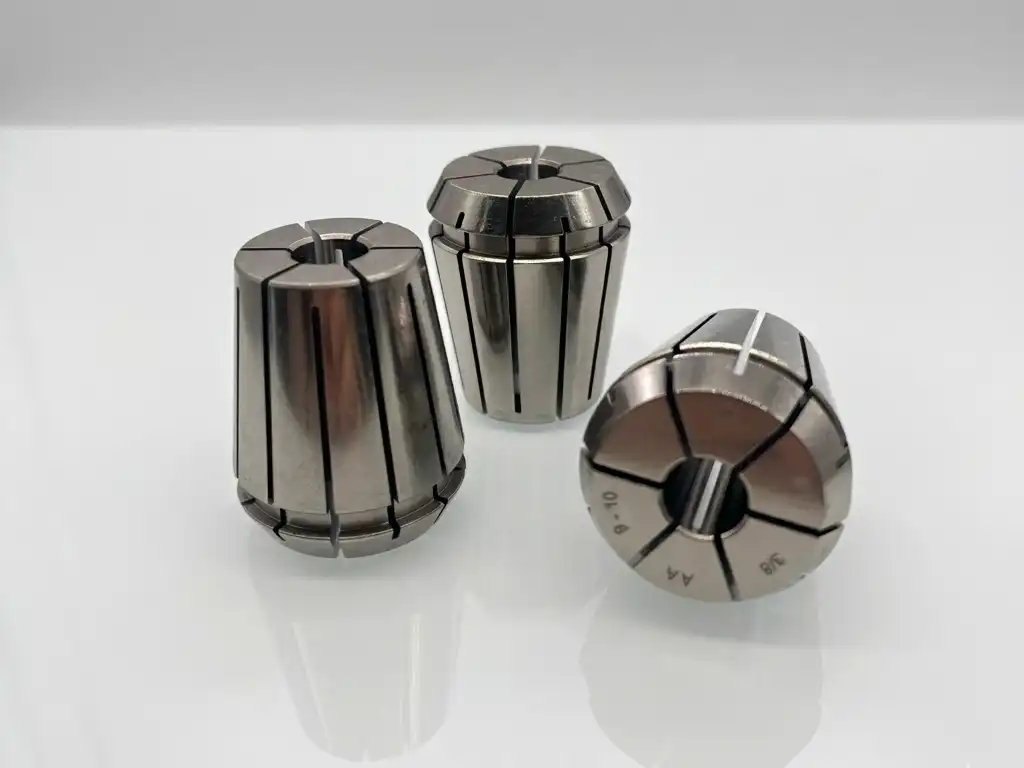
What Makes a Collet Chuck Different?
At first glance, drill chucks and collet chucks may look similar — both hold cutting tools in place.
The difference lies in how they grip the tool.
A drill chuck uses a three-jaw mechanism that contacts the tool at limited points. A collet chuck, by comparison, clamps around the entire tool shank with nearly full 360° contact.
This more even clamping improves:
- Concentricity
- Clamping consistency
- Radial rigidity
- High-speed stability
In CNC machining, small differences in holder performance often become noticeable in the final machining result.
Especially in production environments where repeatability matters, holder stability becomes just as important as cutting tool quality.
Better Concentricity Means Better Accuracy
Precision machining starts with consistency.
Excessive T.I.R. causes the cutting edge to rotate unevenly around the spindle centerline, which often leads to:
- Inconsistent dimensions
- Poor surface finish
- Oversized holes
- Uneven tool wear
Because collet chucks grip the tool more evenly, they generally achieve lower runout than standard drill chucks.
For shops working with tighter tolerances, the difference becomes noticeable quickly — not only in machining quality, but also in reduced rework and scrap.
A stable holder also helps protect carbide tooling.
Excessive runout can create uneven chip load on cutting edges, increasing the risk of premature micro-chipping and shortening tool life.
Better Clamping Means More Stable Machining
One of the biggest advantages of a collet chuck is more consistent clamping force.
During machining, especially milling operations, the cutting tool experiences continuous radial cutting loads.
If the holder lacks rigidity, even slight movement at the tool shank can lead to:
- Vibration
- Reduced repeatability
- Dimensional inconsistency
- Premature tool wear
Unlike drill chucks that rely on three contact points, collet systems hold the tool with much larger contact area around the shank.
This improves holding stability and significantly reduces the risk of tool pull-out during demanding machining operations.
For carbide tooling and higher cutting speeds, this added stability often makes a measurable difference.
Why Collet Chucks Perform Better at Higher RPM
As spindle speed increases, balance becomes increasingly important.
Drill chucks contain moving jaws and internal threaded components, making them naturally harder to balance for high-speed machining.
At higher RPM, imbalance can negatively affect:
- Surface finish
- Tool life
- Spindle stability
- Machining consistency
Precision collet holders are commonly balanced to standards such as G2.5 or G6.3 for high-speed applications.
For shops running carbide tooling or higher spindle speeds, better balance helps reduce vibration and maintain more consistent cutting performance.
Collet Chucks Help Extend Tool Life
Tool wear is not only affected by material hardness or cutting parameters.
Unstable tool holding can be just as damaging.
A properly selected collet chuck helps reduce:
- Micro vibration
- Uneven chip load
- Edge chipping
- Heat concentration during cutting
This becomes especially important when machining:
- Stainless steel
- Hardened materials
- Tight tolerance parts
- Long production runs
The more expensive the cutting tool, the more important holder stability becomes.
Protecting carbide tooling starts with creating stable cutting conditions.
When Are Collet Chucks Worth It?
For basic drilling work or low-speed operations, a standard drill chuck may still be enough.
However, collet chucks become a better choice when:
Tight tolerances matter
When dimensional variation must be kept to a minimum.
Milling operations are involved
Radial cutting forces require greater rigidity and holding stability.
Higher spindle speeds are used
Better balance helps maintain smooth machining performance.
Carbide tooling is used regularly
Improved stability helps extend tool life and reduce tooling cost.
Production consistency matters
Especially in repeated production where repeatability is critical.
Precision Is Also an Economic Decision
Precision tooling is not only about achieving tighter tolerances.
It also affects machining cost.
Poor holder stability often increases:
- Scrap rates
- Tool consumption
- Downtime
- Machining inconsistency
Although a precision collet system may cost more upfront, it often lowers the overall cost-per-part by improving tool life and reducing process variation.
For CNC shops using carbide inserts or solid carbide tooling in production work, stable tool holding quickly becomes a long-term cost advantage.
How to Choose the Right Collet Chuck
Not all collet systems are the same.
Factors such as:
- ER size (ER11, ER16, ER32, ER40)
- Tool diameter range
- Runout requirements
- Clamping force
- Application type
all influence holder performance.
In our next guide, we explain how to choose the right collet chuck for different machining requirements and how ER11, ER16, and ER32 systems compare.
Conclusion
Collet chucks are preferred for precision machining because they improve the factors that matter most:
- Accuracy
- Stability
- Rigidity
- Tool life
- Machining consistency
A high-performance cutting tool can only perform as well as the holder behind it.
For shops looking to improve machining quality, reduce insert wear, or achieve more consistent production results, upgrading the tool holding system is often one of the most practical improvements.
Looking to improve machining stability, surface finish, or carbide tool life?
Our team supports CNC shops with reliable tooling recommendations based on machining materials, tolerance requirements, and production goals.
Whether you are optimizing drilling, milling, or insert performance, we are happy to help you find a more stable and cost-effective tooling solution.