
Drilling & Toolholding guide
How to Choose a Drill Chuck for CNC Machining (Complete Guide + When to Upgrade)
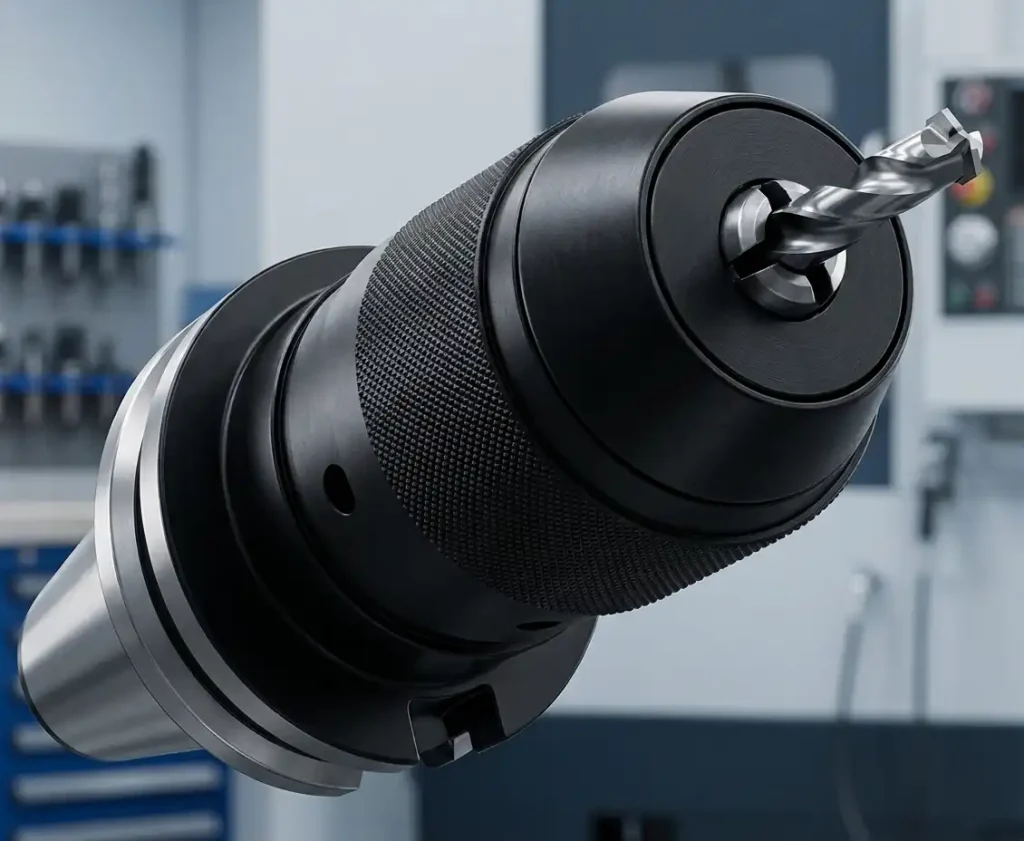
Choosing the Right Drill Chuck for CNC: Key Factors, Limitations, and Alternatives
What Is a Drill Chuck?
A drill chuck is a tool-holding device designed to clamp round shank tools such as drills. Most commonly, it uses a three-jaw mechanism to grip the tool, either with a key (keyed chuck) or by hand (keyless chuck).
In CNC environments, drill chucks are typically used for straightforward drilling operations where convenience matters more than precision.
Can You Use a Drill Chuck in CNC Machines?
Yes—you can.
But whether you should depends on the application.
A drill chuck works reasonably well for:
- General drilling
- Low-precision holes
- Prototyping or small-batch work
However, once you move beyond basic drilling, its limitations become noticeable.
How to Choose the Right Drill Chuck
If you plan to use a drill chuck in CNC, these factors matter more than they appear on paper:
1. Clamping Range
Make sure the chuck covers your tool diameter range properly. Operating near the limits reduces stability.
2. Accuracy (Total Indicator Runout – T.I.R.)
Runout is one of the main performance bottlenecks.
Even small T.I.R. values can affect:
- Hole size consistency
- Surface finish
- Tool life
For tighter tolerance work, this becomes critical.
3. Taper Interface Compatibility
Ensure proper matching with your machine interface (BT, CAT, or other taper systems). Poor interface contact can introduce additional runout and vibration.
4. Speed Rating & Balance
Not all drill chucks are suitable for high-speed CNC spindles.
Due to their internal structure (jaws + screw mechanism), drill chucks are inherently less balanced than precision holders.
At higher speeds, imbalance becomes a limiting factor.
In comparison, precision tool holders are typically balanced to standards such as G6.3 or G2.5.
5. Application Scope
Be realistic about usage:
- Drilling → acceptable
- Milling / slotting → not recommended
Drill chucks are designed primarily for axial loads.
They lack the rigidity required to handle radial loads generated during milling.
Common Problems When Using a Drill Chuck in CNC
In real machining conditions, the following issues are common:
Poor Hole Accuracy
Excessive T.I.R. leads to inconsistent hole size and reduced precision.
Insufficient Clamping Force
Under higher cutting loads, especially with carbide tools, inadequate clamping force can lead to micro-movement or sudden tool pull-out.
In many cases, this results in premature tool failure or even edge chipping.
Vibration at Higher Speeds
The three-jaw structure is not ideal for dynamic balance.
At elevated spindle speeds, vibration affects both machining quality and tool life.
Reduced Tool Life
Instability in the holding system directly translates into inconsistent cutting conditions, accelerating wear.
Even high-quality cutting tools cannot perform reliably under these conditions.
When a Drill Chuck Is Not Enough
There is a clear point where a drill chuck becomes the limiting factor.
You should consider upgrading if:
- You require consistent dimensional accuracy
- You perform milling operations
- You run higher spindle speeds
- You machine harder materials (e.g. stainless steel)
- Tool life becomes unpredictable
Attempting to use a drill chuck beyond its intended application—especially under radial loads—can lead to tool pull-out or even chuck damage.
Drill Chuck vs Collet Chuck (Quick Comparison)
| Feature | Drill Chuck | Collet Chuck |
|---|---|---|
| Accuracy | Moderate | High |
| T.I.R. | Higher | Low |
| Clamping Force | Medium | Strong & uniform |
| Balance | Limited | High-speed ready |
| Application | Drilling | CNC machining |
For basic work, a drill chuck is sufficient.
For precision machining, collet chucks provide better stability and consistency.
Recommended Setup for Better CNC Performance
From a practical standpoint:
- Basic setup
Drill Chuck + standard drills → suitable for general drilling - Improved setup
Collet Chuck + high-quality cutting tools → improved accuracy and stability
If you are already optimizing cutting parameters but still facing inconsistency, the tool holding system is often the missing factor.
At the same time, cutting tools remain equally important.
Choosing the right inserts for your material and operation can significantly improve machining results.
Conclusion
A drill chuck is a practical solution for basic CNC drilling tasks.
However, its limitations are clear:
- Higher T.I.R.
- Limited clamping force
- Poor balance at high speeds
For more demanding applications, upgrading the tool holding system becomes necessary.
In CNC machining, performance depends on the combination of:
- Tool holding
- Cutting tools
- Machining parameters
Ignoring any one of these will limit the overall result.