
Milling guide
Finishing Milling Guide: 5 Tips for Superior Surface Finish in CNC Machining
Finishing Milling: How to Achieve Better Surface Finish in CNC Machining
What Is Finishing Milling in CNC Machining
Finishing milling is the final stage of a machining process, where the goal is to improve surface finish, achieve tight tolerance, and ensure high dimensional accuracy. In CNC milling, this stage follows roughing operations, where large amounts of material are removed.
Unlike roughing, finishing focuses on creating a smooth surface with minimal tool marks. The milling process requires precise control of feed rate, cutting forces, and tool path to achieve the best possible finish on the workpiece.
A typical CNC machine or milling machine performs finishing operations using optimized milling tools and stable machine tools to reduce vibration and deflection.
What Is a Finishing End Mill
A finishing end mill is a type of cutting tool designed specifically for finishing operations. Compared to a roughing end mill, the finishing end mill has a sharper cutting edge and optimized geometry to produce a smoother finish.
Key features include:
- Higher flute count for better surface quality
- Optimized helix angle for stable cutting
- Sharp or radiused corner radii depending on application
- Solid carbide construction for longer tool life
Different types of endmills, including square end, ball end, and radiused tools, are used depending on the contour or profile milling requirements.
Roughing and Finishing Milling: Key Differences
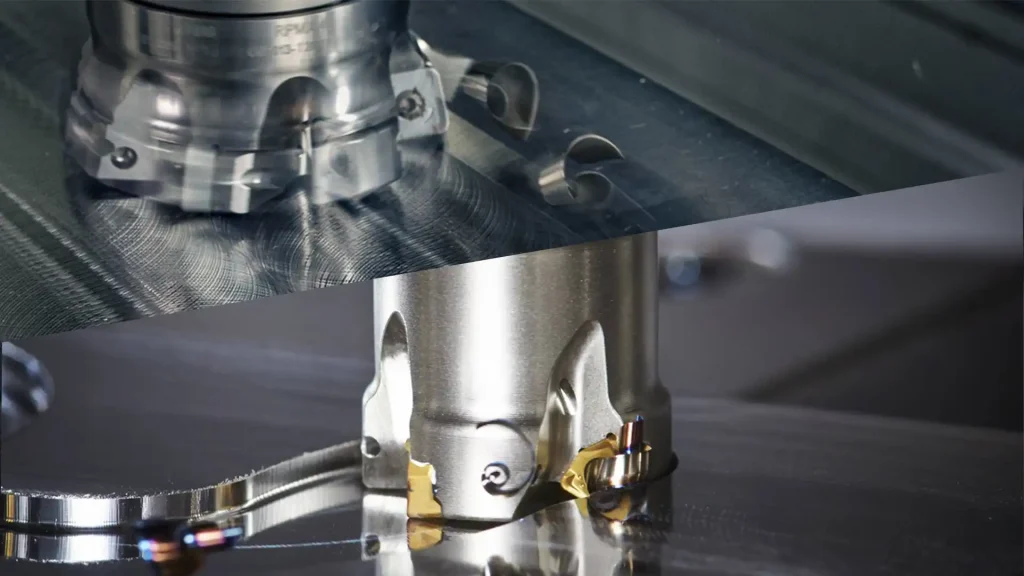
Roughing and finishing are two essential stages in any CNC milling operation.
| Feature | Roughing | Finishing |
|---|---|---|
| Purpose | Removes material quickly | Improves surface finish |
| Tool | Roughing end mill | Finishing end mill |
| Cutting Forces | High | Lower cutting forces |
| Surface Quality | Rough | Smooth |
| Depth of Cut | Large | Reduced depth of cut |
Roughing operations focus on high material removal rates, while finishing operations aim to improve surface roughness and meet surface finish requirements.
Using Roughing and Finishing End Mills Together
In real machining environments, roughing and finishing are combined to optimize efficiency and quality.
During roughing operations, tools like roughing end mills are used for aggressive cutting. Then, finishing passes are applied using finishing end mills to refine the surface.
This approach helps:
- Improve surface finish and surface quality
- Reduce tool wear during finishing
- Achieve tighter tolerance and dimensional accuracy
However, in high-volume production, using multiple solid tools may increase costs. In such cases, indexable solutions such as carbide inserts can replace or complement traditional milling cutters.
Key Factors That Affect Surface Finish
Achieving a better surface finish depends on multiple factors:
Tool Geometry
The geometry of the end mill, including flute design, helix angle, and corner radii, directly affects chip formation and surface roughness.
Cutting Parameters
Feed rate, spindle speed, and depth of cut must be optimized. Lower feed rates and reduced cut depth generally produce a smoother finish.
Machine Stability
A rigid CNC machine reduces vibration, preventing tool deflection and improving surface quality.
Tool Path Strategy
Optimized tool path strategies in contour and profile milling help achieve a smoother finish and minimize tool marks.
Common Finishing Milling Operations
Different milling operations require different tools and strategies:
Profile Milling
Used to machine external shapes and contours on a workpiece.
Face Milling
Used to produce flat surfaces with a better surface finish.
Contour Milling
Critical for complex geometries and mold machining.
Milling Deep Cavities
Requires careful control of tool diameter and length of the tool to avoid deflection.
Choosing the Right Finishing Tool
Choosing the right tool is critical for achieving optimal results.
Factors to consider:
- Workpiece material (steel, carbide, plastic, etc.)
- Tool diameter and shank stability
- Tool holder and clamp setup
- Required surface finish and tolerance
n some cases—especially in face milling or large-scale finishing—indexable cutters with carbide inserts can deliver a superior surface finish. These tools provide higher cost efficiency through multiple cutting edges per insert and offer shorter lead times compared to custom solid tools.
Tool Geometry: Flute, Helix, and Corner Radii
The geometry of a milling cutter plays a major role in finishing performance. In finishing applications, it’s not just about the number of flutes. A variable helix design and unequal flute spacing are essential to suppress chatter (vibration), which is the enemy of a mirror-like surface finish.
- Flute count: More flutes generally improve surface finish but require a balance with chip evacuation space.
- Helix angle: Higher helix angles reduce cutting forces; however, variable helix designs are preferred for high-stability finishing.
- Corner radii: Radiused edges increase tool life and reduce stress concentration on the workpiece.
Conventional Milling vs Climb Milling in Finishing
In finishing operations, climb milling is generally preferred over conventional milling.
- Climb milling produces a smoother finish
- It reduces cutting forces and tool wear
- It improves surface roughness consistency
However, machine rigidity and setup conditions must be considered.
Common Mistakes in Finishing Milling
- Using tools designed for roughing operations
- Incorrect feed rate or excessive depth of cut
- Poor chip evacuation
- Using a longer tool than necessary, causing deflection
Avoiding these issues helps improve surface quality and tool life.
FAQ About Finishing Milling
What is finishing milling used for?
It is used to improve surface finish and achieve tight tolerance after roughing.
What tool is best for finishing milling?
A finishing end mill or, in some cases, indexable inserts depending on the application.
How to achieve a better surface finish?
Optimize feed rate, tool geometry, and machine stability.
Conclusion
Finishing milling is a critical step in CNC machining that determines the final surface quality, tolerance, and overall part performance.
By selecting the right tool, optimizing cutting parameters, and understanding the differences between roughing and finishing, machinists can achieve a better surface finish and improve overall efficiency.
For many applications, combining solid carbide tools with FH provides a more flexible and cost-effective machining strategy.