
Milling guide
Roughing End Mill: Complete Guide
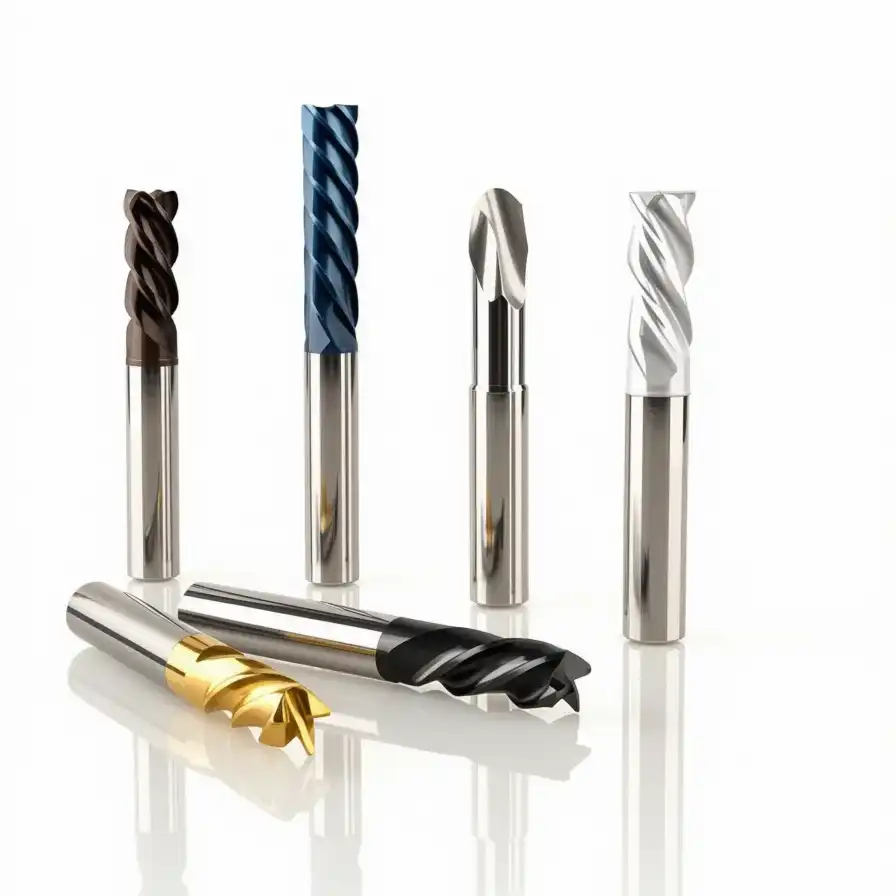
Roughing End Mill: Complete Guide for CNC Machining
What Is a Roughing End Mill?
A roughing end mill is a type of end mill designed for aggressive material removal in CNC machining. Unlike standard end mills, it features a serrated cutting edge that breaks chips into smaller pieces, reducing cutting forces and improving chip evacuation.
This makes roughing end mills especially suitable for:
- Heavy cutting operations
- Deep slotting
- Machining tough materials
Because of their geometry, rough end mills prioritize efficiency over surface finish, making them ideal for the first stage of machining.
Why Use a Roughing End Mill?
Roughing end mills are widely used in CNC machining due to their ability to remove large volumes of material quickly and efficiently.
Key advantages:
- High Material Removal Rate (MRR): Engineered for heavy-duty metal stripping and shortened cycle times.
- Superior Chip Evacuation: The chip-breaker geometry chops swarf into small, manageable segments, preventing “bird-nesting” in deep pockets.
- Thermal Management: Reduced contact area at the cutting zone helps dissipate heat, extending tool life in tough alloys.
Roughing End Mill vs Finishing End Mill
Understanding the difference between roughing and finishing tools is essential for optimizing machining performance.
| Feature | Roughing End Mill | Finishing End Mill |
|---|---|---|
| Purpose | Rapid material removal | Surface finishing |
| Cutting Edge | Serrated | Smooth |
| Feed Rate | High | Low |
| Surface Finish | Rough | Fine |
| Cutting Load | Heavy | Light |
In most machining workflows, roughing is followed by finishing to achieve final dimensional accuracy and surface quality.
Using Roughing and Finishing End Mills Together
In practical CNC machining, roughing and finishing end mills are rarely used independently. Instead, they are typically combined in a structured machining process to achieve both efficiency and precision.
Typical Workflow
A standard machining process often follows this sequence:
- Roughing Stage
A roughing end mill is used to remove the majority of material quickly, reducing machining time. - Semi-Finishing (Optional)
In some applications, an intermediate step is used to improve dimensional stability. - Finishing Stage
A finishing end mill is applied to achieve the final surface quality and tight tolerances.
Why This Combination Matters
Using roughing and finishing tools together allows manufacturers to:
- Maximize material removal efficiency
- Reduce overall machining time
- Improve surface finish quality
- Extend tool life by distributing cutting load
When This Approach Is Not Ideal
In high-volume or cost-sensitive production environments, using multiple solid tools may increase tooling costs.
In such cases, many manufacturers shift to indexable tooling solutions, where roughing and finishing operations can be optimized using replaceable cutting edges such as carbide inserts.
Types of Roughing End Mills
Roughing end mills come in different designs depending on machining needs:
1. Coarse Pitch Roughing End Mills
- Larger serrations
- Better for heavy material removal
2. Fine Pitch Roughing End Mills
- Smaller serrations
- More stable cutting, better surface control
3. Variable Pitch Designs
- Reduce vibration
- Improve tool life
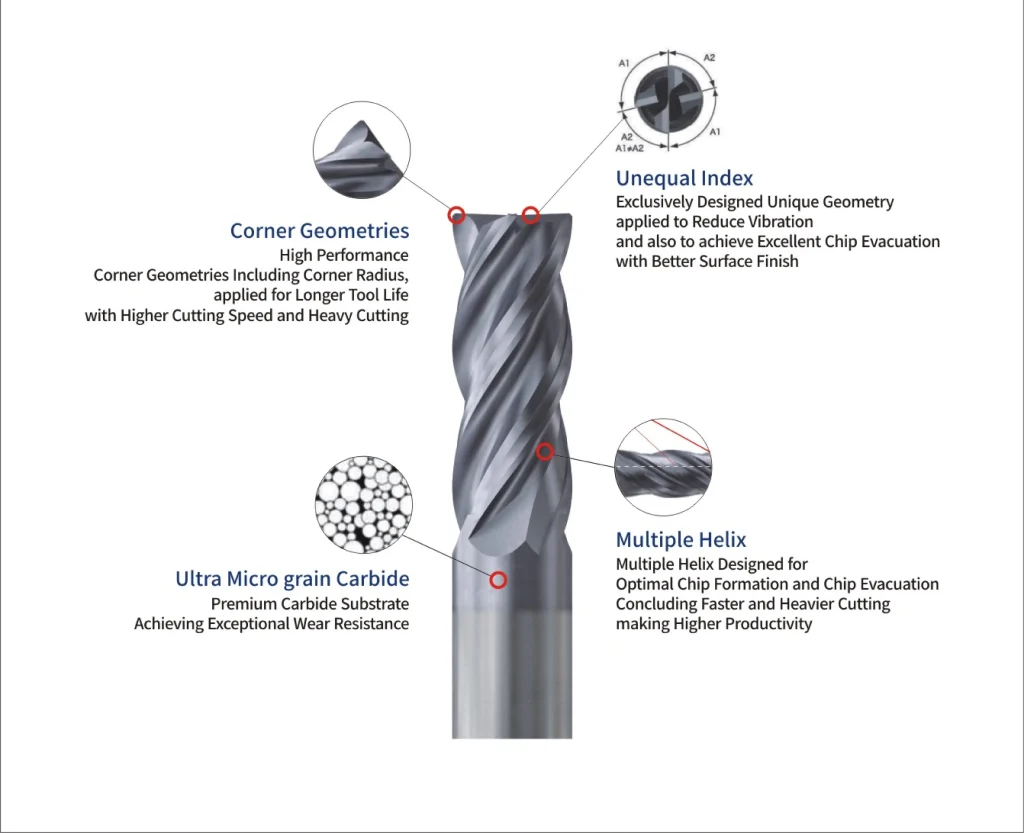
4. Coated Roughing End Mills
- TiAlN / AlTiN coatings
- Better heat resistance and wear resistance
How to Choose the Right Roughing End Mill
Selecting the correct roughing end mill depends on several practical machining factors:
Workpiece Material
- Steel → General-purpose or coated tools
- Stainless steel → Sharp geometry + coating
- Cast iron → Wear-resistant grade
Machine Rigidity
- Low rigidity → Use fine pitch for stability
- High rigidity → Use coarse pitch for maximum efficiency
Depth of Cut & Feed Rate
- Deep cuts → Stronger geometry
- High feed → Optimized chip evacuation
Cost vs Tool Life
In many cases, users must balance tool cost and performance. While solid carbide tools offer precision, they can be expensive in high-volume roughing operations.
Solid Carbide vs. Indexable Tooling: Which is Right for You?
While solid carbide roughing end mills are excellent for smaller diameters and intricate cavity work, they are not always the most economical choice for large-scale material removal.
Indexable Milling Cutters (using carbide inserts) become the superior choice when:
- Large Diameters are required: Typically anything over 16mm or 20mm.
- Cost-per-edge is a priority: You only replace the insert, not the entire tool body.
- High-Volume Production: Minimized downtime with quick insert indexing.
When roughing end mills are suitable:
- Small to medium batch production
- Flexible machining setups
- Complex geometries
When indexable tools are a better option:
- Large material removal
- High-volume production
- Cost-sensitive operations
- Need for replaceable cutting edges
In many cases, manufacturers prefer indexable tooling such as carbide inserts for heavy-duty roughing because they offer:
- Lower cost per edge
- Longer overall tool life
- Faster tool replacement
By utilizing indexable solutions, manufacturers can access a cost-efficient alternative to major international brands without compromising on tool life or machining stability.
Typical Applications of Roughing End Mills
Roughing end mills are commonly used in:
- Steel machining – general roughing operations
- Stainless steel – controlled cutting with proper coating
- Cast iron – stable high-speed removal
- Mold and die machining – cavity roughing
In larger-scale operations, these applications are often partially or fully replaced by indexable tooling solutions for better efficiency.
Common Mistakes to Avoid
- Using finishing end mills for heavy roughing
- Choosing the wrong flute design
- Poor chip evacuation leading to tool wear
- Ignoring machine rigidity limits
Avoiding these mistakes can significantly improve machining efficiency and tool life.
FAQ About Roughing End Mills
What is a roughing end mill used for?
It is used for rapid material removal in the early stage of machining.
Can a roughing end mill be used for finishing?
Not recommended. It leaves a rough surface and lacks precision.
How many flutes should a roughing end mill have?
Typically 3–5 flutes, depending on material and cutting conditions.
Conclusion
Roughing end mills play an important role in CNC machining by enabling fast and efficient material removal. However, they are just one part of a broader tooling strategy.
For manufacturers looking to optimize both cost and performance, it is worth evaluating alternative solutions such as indexable tooling and carbide inserts, especially in high-volume or heavy-duty applications.